

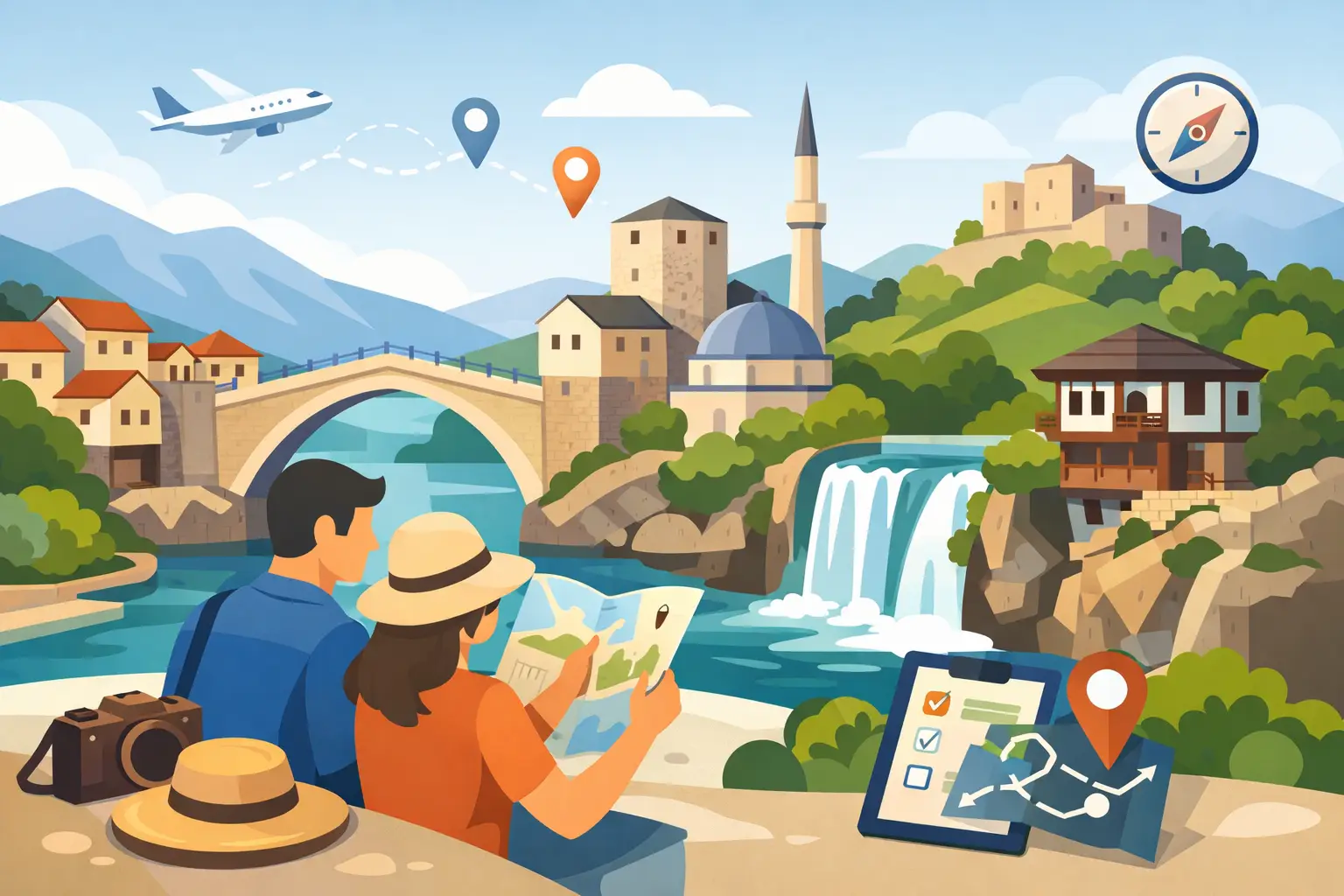
A strong Bosnia heritage tour guide starts with one practical reality: this is not a destination you rush through if culture is the reason you came. Bosnia and Herzegovina rewards travelers who want context, not just checklists – Ottoman streets beside Austro-Hungarian facades, mosques near Catholic cathedrals and Orthodox churches, and recent history that still shapes how places are presented today.
For travelers comparing Balkan itineraries, Bosnia often becomes the most memorable stop because its heritage feels lived-in rather than staged. The country is compact enough for a structured trip, but layered enough that route design matters. If your goal is to understand Bosnia rather than simply pass through it, the right tour should balance landmark sites, regional contrast, and enough guided interpretation to make the history clear.
What a Bosnia heritage tour guide should actually cover
Not every cultural itinerary in Bosnia is truly heritage-led. Some tours use Sarajevo and Mostar as scenic highlights, then move on quickly. That works for first-time Balkan travelers with limited time, but it is not the same as a heritage-focused journey.
A well-built Bosnia heritage tour guide should help you evaluate four things: historical range, regional coverage, pacing, and narrative quality. Historical range matters because Bosnia’s story spans medieval kingdoms, Ottoman rule, Austro-Hungarian administration, Yugoslav modernity, and the 1990s war. If a tour only covers one era, the picture stays incomplete.
Regional coverage matters because Sarajevo and Mostar are essential, but they do not tell the whole story. Central Bosnia, Herzegovina, and smaller heritage towns add depth. Pacing is equally important. A packed one-day overview can be efficient, yet it rarely leaves room for museums, religious sites, or the kind of walking tours that explain why architecture and identity are so closely linked here.
Narrative quality is the real differentiator. Bosnia is a destination where a guide’s ability to explain nuance can shape the entire experience. The strongest tours do more than point out monuments. They explain coexistence, rupture, rebuilding, and how local communities interpret heritage today.
Core stops in a Bosnia heritage tour guide
Sarajevo
Sarajevo is the anchor for almost any serious heritage itinerary. The city’s old bazaar district, Baščaršija, is often the visual starting point, but the value of Sarajevo goes far beyond atmosphere. Within a relatively small area, travelers can see Ottoman urban design, Austro-Hungarian civic buildings, synagogues, mosques, churches, and memorials tied to the late 20th century.
This is also where guided touring adds the most value. Without context, Sarajevo can feel like several different cities joined together. With a knowledgeable guide, the layers become readable. You start to understand how imperial influence, religion, trade, and conflict shaped both the streetscape and the city’s identity.
If time allows, Sarajevo deserves at least two nights. One day covers the historic center well, but a second day improves the experience significantly, especially if you want museums, war history sites, and a slower look at local cultural life.
Mostar
Mostar is Bosnia’s most recognized heritage stop for good reason. The Old Bridge is iconic, but the surrounding old town, river setting, and mix of rebuilt and preserved architecture give the city substance beyond the postcard view.
That said, Mostar can be mistimed. Midday crowds are common, especially in peak season, and day-trippers often experience only the commercial core. Heritage travelers do better with an overnight stay or a carefully scheduled visit that allows time early or late in the day.
Mostar works best when presented as both a historical city and a case study in destruction and reconstruction. The bridge is not just a landmark. It is also a symbol of heritage loss, international restoration, and the role of monuments in postwar identity.
Blagaj, Počitelj, and Herzegovina extensions
If you want more than the standard circuit, Herzegovina offers strong additions. Blagaj combines natural setting with Ottoman-era heritage, while Počitelj provides one of the region’s most distinctive historic urban ensembles. These are the kinds of stops that separate a basic sightseeing program from a more complete cultural route.
They also help pace the south better. Rather than treating Mostar as a single stop, a wider Herzegovina day gives travelers a stronger sense of regional history and landscape. For small-group touring, this is often the sweet spot – manageable logistics with a richer heritage payoff.
Jajce and central Bosnia
Jajce is one of Bosnia’s most rewarding heritage towns, especially for travelers interested in medieval and Yugoslav history. Its fortress, historic center, and political significance during World War II make it relevant on multiple levels.
Central Bosnia generally receives less attention than Sarajevo or Mostar, yet it adds important perspective. Depending on the route, this region can introduce monastic sites, fortified towns, and a more localized view of Bosnia’s cultural diversity. It is a strong option for repeat Balkan travelers who want to move beyond the obvious highlights.
Choosing the right tour format
The best Bosnia heritage tour guide is not only about where to go. It is also about choosing the format that matches how you travel.
Escorted multi-day tours suit travelers who want reliable structure, hotel coordination, and guided continuity across several cities. This is usually the best option if Bosnia is part of a larger Balkan itinerary. It removes the friction of transfers, border timing, and site scheduling while keeping the historical thread intact.
Small-group touring often offers the best balance. It is easier to manage in old towns, more flexible with stops, and generally better for travelers who want a cultural trip without the feel of a large coach program. For heritage travel, group size matters because museums, walking segments, and local interaction all work better when the pace stays controlled.
Private touring makes sense if your priorities are specific – religious heritage, war history, Jewish heritage, architecture, or photography, for example. It costs more, but the trade-off can be worth it if your interests are focused and your schedule is tight.
When to go for the best heritage experience
Spring and early fall are typically the strongest seasons for a Bosnia heritage trip. You get better walking conditions, fewer crowds than high summer, and more comfortable touring in historic centers where much of the experience happens outdoors.
Summer has advantages, especially for travelers combining Bosnia with the Adriatic or a broader Balkan route. Longer daylight hours help, and the country is lively. But there are trade-offs. Mostar can be very hot, and headline sites are busier. If you travel in summer, smart timing matters more than ever.
Winter works for Sarajevo if your itinerary includes seasonal atmosphere or nearby mountain stays, but it is less ideal for a broad heritage circuit unless you are comfortable with shorter days and weather-related variability.
What to ask before booking
A heritage itinerary should be judged by substance, not just map pins. Ask whether key site entries are included, how much guided walking is built in, and whether the tour provides historical interpretation or mostly handles transportation. Those details affect value more than the headline price.
It is also worth asking how much free time is scheduled. Some travelers want independent museum visits or time to experience old town districts at their own pace. Others prefer a more guided structure. Neither approach is wrong, but the right fit depends on your travel style.
If Bosnia is one part of a multi-country program, look closely at transit days. A regional itinerary can be efficient, but only if Bosnia receives enough time to justify the stop. One rushed overnight may be enough for orientation, though not for a real heritage experience.
For travel advisors and planners, this is where a destination-focused operator adds clear value. Regional expertise helps avoid thin routing and supports better sequencing between Bosnia and nearby markets. Master DMC, for example, is strongest when building Bosnia into broader Balkan programs without reducing it to a quick add-on.
The real value of a Bosnia heritage trip
Bosnia is not a heritage destination in the polished, museum-piece sense. That is exactly why it stays with people. Its most important sites are part of active cities and towns, shaped by daily life, memory, and ongoing interpretation.
A good tour does not try to simplify that complexity too much. It gives travelers enough structure to move smoothly and enough context to understand what they are seeing. If you choose well, Bosnia will not feel like a secondary stop between bigger-name countries. It will feel like the place that made the entire trip more meaningful.
Plan for depth, not just coverage, and Bosnia will give you more than landmarks. It will give you a clearer sense of how history lives in a destination long after the guide finishes talking.