
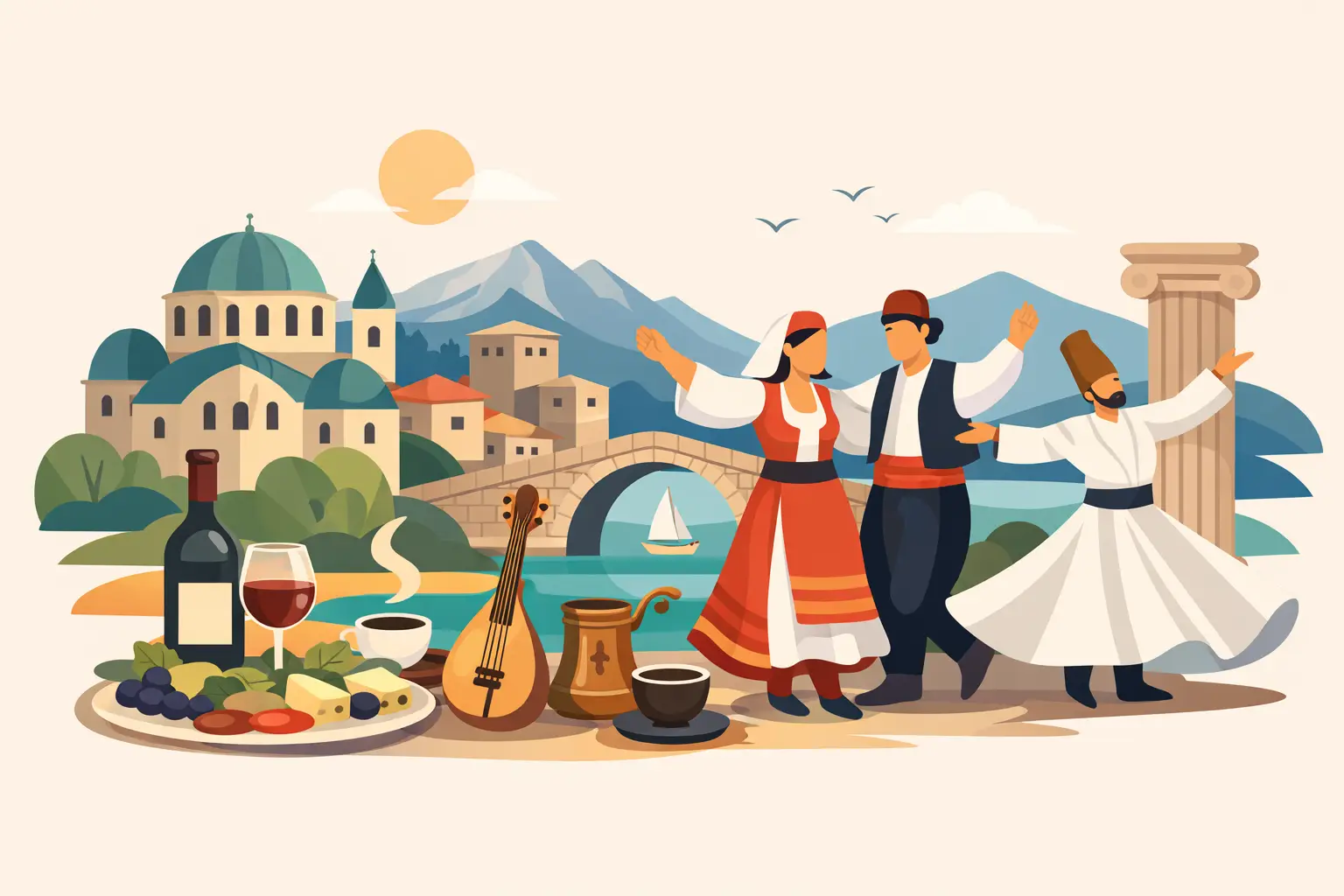
A brass band cuts through the afternoon in Serbia, church bells carry over a stone square in Croatia, and a family table in Albania keeps filling long after you thought the meal was over. The best Balkan cultural experiences are not staged moments created for visitors. They are part of daily life in a region where history is visible, hospitality is taken seriously, and local identity still shapes how people eat, celebrate, and gather.
For travelers who want more than a checklist of landmarks, the Balkans offer unusual depth. This is not one culture presented in different settings. It is a compact region of distinct languages, faiths, empires, cuisines, and customs that often overlap within a single itinerary. That variety is exactly what makes the Balkans such a strong fit for multi-country travel, especially when logistics are planned well and each stop adds a different cultural angle.
What makes the best Balkan cultural experiences stand out
The strongest cultural experiences in the Balkans feel lived-in rather than packaged. A market visit in Sarajevo, a folklore evening in North Macedonia, or a wine tasting in Romania can all work well, but only if they are rooted in place and paced properly. Travelers often get the most value when culture is not treated as an add-on between transfers, but as the reason for the route itself.
It also helps to understand the trade-off between breadth and depth. A fast itinerary can give you an excellent regional overview, especially if you want to compare capitals, old towns, and major heritage sites. But if your goal is real local contact, traditional food, and a better sense of how communities differ across the Balkans, slower pacing matters. Two nights instead of one can change the quality of the experience entirely.
1. Walk the old quarters where Ottoman, Venetian, and Austro-Hungarian layers meet
One of the clearest ways to understand the Balkans is on foot. Cities such as Sarajevo, Mostar, Dubrovnik, Kotor, Plovdiv, and Berat show how different empires left distinct marks on architecture, religion, and street life. In some places, a short walk takes you from a mosque to an Orthodox church to a Catholic cathedral, with local shops and coffee houses in between.
This works best with strong guiding, because the details matter. Without context, an old town can become just another photogenic stop. With context, the stones start to explain trade routes, political change, and the way Balkan cities still carry multiple identities at once.
2. Attend a local festival, not just a headline event
Festivals are among the best Balkan cultural experiences because they show how communities present themselves to each other, not just to tourists. Summer music festivals get attention, but smaller religious celebrations, harvest events, village fairs, and folklore gatherings often leave a stronger impression.
Timing is the main variable here. Festival-based travel can be rewarding, but it is less flexible and often more crowded. If you want atmosphere and authenticity without the pressure of peak dates, ask for itineraries that include regional celebrations rather than only the biggest international events.
3. Share a traditional meal in a family-run setting
Food in the Balkans is never only about food. It is about welcome, family rhythm, seasonal ingredients, and regional identity. A proper meal in Bosnia and Herzegovina feels different from one in Bulgaria or coastal Montenegro, even when some ingredients overlap. Preparation methods, table customs, and the sequence of dishes reveal a lot about the place you are in.
The best version of this experience is not the most formal. It is often a long lunch in a village household, winery, or rural guesthouse where recipes are explained and conversation comes naturally. Structured culinary stops still matter, especially on escorted tours, but they should feel regional rather than generic.
4. Hear the music where it belongs
Balkan music is highly localized. Brass traditions in Serbia, sevdah in Bosnia and Herzegovina, klapa singing in Croatia, and folk ensembles in North Macedonia each carry their own cultural weight. Seeing a staged performance can be worthwhile, especially when time is limited, but the setting changes the impact.
A small venue, a local celebration, or an evening tied to a regional dinner usually gives a better result than a large theatrical show. Music in the Balkans is closely linked to life-cycle events, community gatherings, and local pride. When it appears in that context, it tells you more than a museum panel ever could.
5. Visit monasteries and churches that still shape local life
Religious heritage is central to understanding the Balkans. Monasteries in Romania, Orthodox churches in Serbia and North Macedonia, Catholic traditions along the Adriatic, and Islamic heritage in Bosnia and Albania all form part of the region’s cultural fabric. These are not simply historic monuments. Many remain active places of worship and community life.
That is why approach matters. Travelers who enter respectfully and with background knowledge usually take away much more than architecture and frescoes. These visits are especially valuable when paired with nearby towns or rural areas, where you can see how faith traditions continue to influence daily routines, holidays, and identity.
6. Spend time in markets and artisan workshops
Markets are one of the fastest ways to read a destination. You hear the language cadence, see what people buy, and get a feel for local produce, household habits, and informal social life. In the Balkans, markets often reveal strong rural ties even in urban settings.
Artisan visits can add another layer, particularly where textile work, wood carving, ceramics, icon painting, or metal craft are still practiced. Not every workshop visit is equally meaningful, and some can feel overly transactional. The best ones include demonstration, explanation, and enough time for real exchange rather than a quick retail stop.
7. Experience coffee culture in its local form
Coffee matters across the Balkans, but not in the same way everywhere. In Bosnia, Turkish-style coffee carries ritual and conversation. In Croatia and Slovenia, café culture often leans more Central European in feel. In Albania, espresso culture is woven deeply into urban daily life.
This may sound like a small detail, but it is one of the most accessible cultural experiences in the region. Sitting in a square, observing how long people linger, what they order, and how public space is used gives insight into social habits that travelers often miss when moving too quickly from site to site.
8. Follow the region through its wine and rakija traditions
Wine and fruit brandy are part of social life across much of the Balkans. Tasting them in context adds more than flavor. It opens conversations about agriculture, family production, seasonal work, and local pride. Slovenia and Croatia may be more familiar to some US travelers as wine destinations, but Serbia, North Macedonia, Bulgaria, and Romania also reward closer attention.
This is one of the best Balkan cultural experiences for travelers who want structure without formality. A good tasting can be easy to fit into a touring route, especially when paired with lunch, a cellar visit, or a stop in a rural estate. The key is balance. Too many tastings in one itinerary can blur together, while one or two well-chosen visits can anchor the trip.
9. Stay long enough in one smaller town
Major cities deserve their place, but smaller towns often deliver the clearest cultural contact. Places such as Ohrid, Sibiu, Cetinje, Jajce, or Korca can slow the pace in the right way. You notice evening routines, local promenades, family dining patterns, and the social use of town squares.
This is where professionally designed routing makes a difference. Travelers often assume cultural depth comes from adding more stops. In practice, one smaller destination with a well-planned overnight can offer more than three rushed headline cities in two days.
10. Choose itineraries that compare cultures, not just countries
The Balkans reward comparison. Seeing Orthodox, Catholic, Muslim, and secular traditions across one trip helps travelers understand that the region is connected, but never uniform. A route that combines, for example, Croatia, Bosnia and Herzegovina, Montenegro, and Albania can show dramatic shifts in architecture, food, and public life over a relatively short distance.
That is why the best Balkan cultural experiences often come from thoughtful sequencing rather than isolated sightseeing. A strong itinerary lets each destination sharpen the next one. For travelers who want convenience without losing nuance, that balance is where a specialist operator adds real value.
How to choose the right cultural trip in the Balkans
If your priority is heritage and architecture, focus on old towns, monasteries, and guided city stays. If you are more interested in food, music, and daily life, look for small-group routes with regional meals, market time, and fewer hotel changes. If this is your first visit, a multi-country overview works well. If you already know one part of the region, a slower country-pairing often delivers more substance.
Season matters too. Spring and early fall usually offer the best mix of comfort, mobility, and local activity. Summer brings energy and long evenings, especially on the Adriatic, but also higher prices and denser crowds. Winter can be excellent for city culture and holiday traditions, though rural access and operating schedules may narrow.
For travelers and advisors alike, the practical question is not whether the Balkans have culture. They do, in abundance. The better question is how to experience it without reducing it to quick photo stops and generic folklore. The right journey gives you context, pacing, and access to the region as it is actually lived – layered, varied, and memorable long after the trip ends.